Where Should You Inject Your GLP-1 Medication? A Guide to Proper Injection Sites and Absorption…
Blog
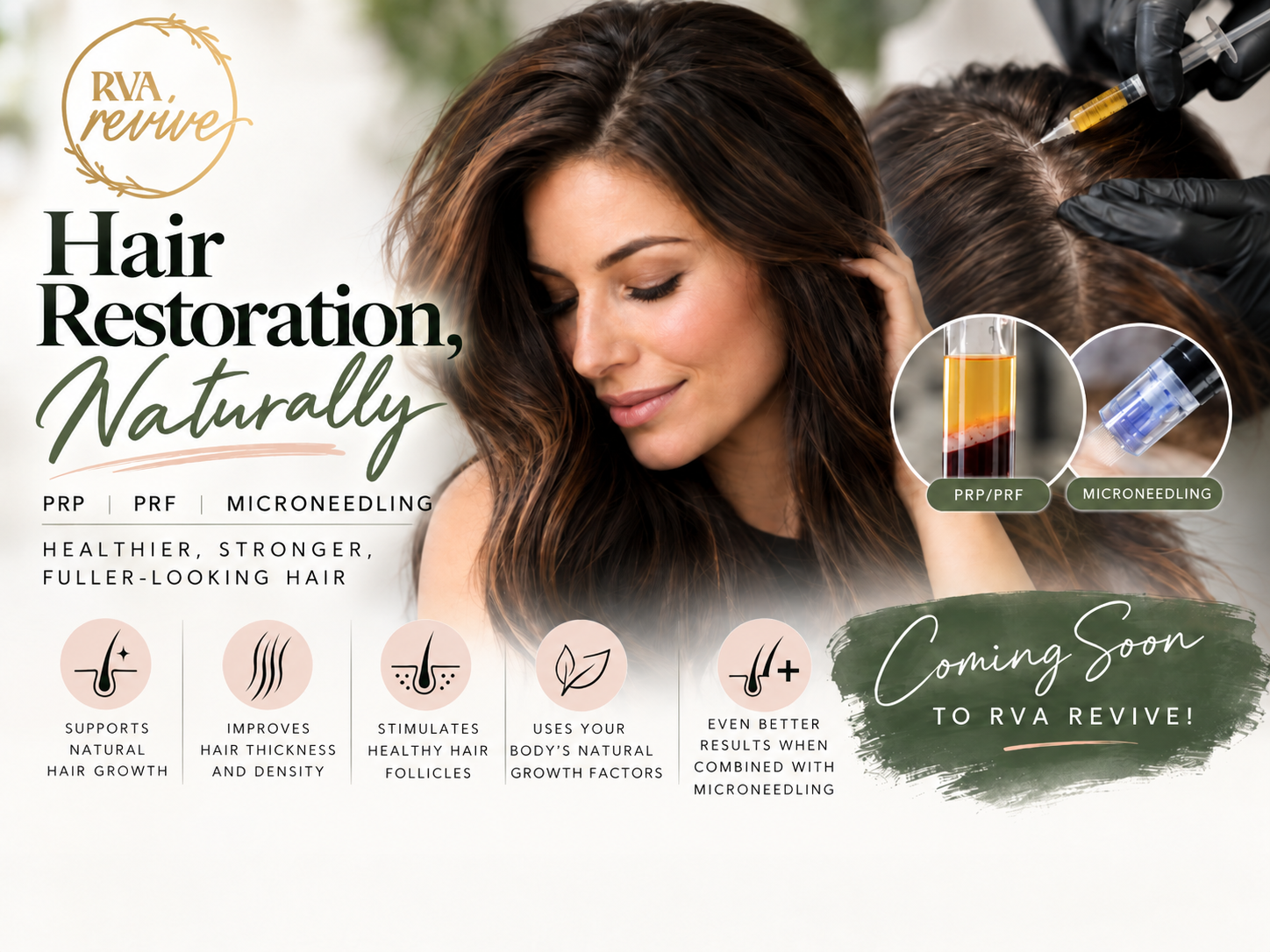
Hair Restoration, Naturally: How PRP, PRF, and Microneedling Can Help Bring Your Hair Back to Life
Coming Soon to RVA Revive!
You notice a few extra strands in the shower. Then a little more hair in your brush. Maybe your ponytail doesn’t feel quite as thick as it used to, or you’re beginning to see more of your scalp when you look in the mirror.
Hair loss can be frustrating, especially when you’re doing everything you can to take care of your health. And while thinning hair is often associated with aging, the reality is that hormonal changes, stress, genetics, nutritional deficiencies, and even rapid weight loss can all contribute to hair loss.
At RVA Revive, we believe hair restoration should be about more than simply covering up the problem. It’s about understanding why your hair is thinning and exploring treatments that support healthier hair growth.
That’s why we’re excited to announce that PRP (Platelet-Rich Plasma), PRF (Platelet-Rich Fibrin), and microneedling for hair restoration are coming soon to RVA Revive!
Understanding Hair Loss: Why Does It Happen?
Before discussing treatments, it helps to understand what’s happening beneath the surface.
Hair grows in cycles. Each follicle moves through a growth phase (anagen), a transitional phase (catagen), a resting phase (telogen), and a shedding phase (exogen). Normally, these cycles occur at different times, so we don’t notice significant shedding.
But certain changes in the body can disrupt this process.
Androgenetic Alopecia (Pattern Hair Loss)
This is one of the most common causes of progressive hair thinning in both men and women. Genetics and sensitivity to hormones called androgens, particularly dihydrotestosterone (DHT), can cause hair follicles to gradually shrink. Over time, the hair becomes finer, shorter, and less dense.
Women may notice a widening part or thinning near the crown, while men commonly experience a receding hairline or thinning at the crown.
Telogen Effluvium: Hair Loss After Stress or Weight Loss
Have you ever noticed increased shedding a few months after a stressful experience, illness, surgery, or significant weight loss?
This is called telogen effluvium.
When the body experiences a significant physiological or emotional stressor, more hair follicles than usual may enter the resting phase. The result is increased shedding, typically appearing two to three months after the triggering event.
We’ve seen how frustrating this can be for individuals working hard to improve their metabolic health and lose weight. You may feel healthier, have more energy, and be making wonderful progress toward your goals—only to notice your hair getting thinner.
Rapid weight loss, inadequate protein intake, iron deficiency, and insufficient overall nutrition can contribute to this process. The shedding is often temporary, but identifying and correcting the underlying cause is essential.
Hormonal Changes and Hair Thinning
Hormones play an important role in the hair growth cycle.
Changes during perimenopause and menopause, postpartum hormonal shifts, thyroid dysfunction, and androgen-related conditions can all influence hair growth and shedding.
For some individuals, hormonal changes can also uncover an underlying genetic tendency toward pattern hair loss.
This is why we believe evaluating the bigger picture matters. Sometimes the most effective hair restoration plan begins with understanding what’s happening inside the body.
What Is PRP Hair Restoration?
PRP stands for Platelet-Rich Plasma, a concentrated portion of your own blood containing platelets and their associated growth factors.
Platelets are best known for helping blood clot, but they also release signaling proteins involved in tissue repair and cellular communication.
Here’s how the process works:
- A small blood sample is collected. Similar to having routine laboratory work performed.
- The blood is placed into a centrifuge. This specialized device spins the blood to separate its components and concentrate the platelets.
- The PRP is collected. The platelet-rich portion is prepared for treatment.
- PRP is introduced into targeted areas of the scalp. Small injections deliver the concentrated plasma near thinning hair follicles.
The goal is to create a more supportive environment for hair follicles by delivering growth factors that may influence follicle activity, blood vessel signaling, and the hair growth cycle.
Research suggests that PRP can improve hair density and, in some patients, hair thickness, particularly in androgenetic alopecia.
Think of PRP as providing additional biological signals to follicles that may still have the potential to produce healthier hair.
It doesn’t create entirely new hair follicles, and it cannot reliably restore hair in areas where follicles have been permanently destroyed. However, it may help improve the performance of existing follicles.
What Is PRF, and How Is It Different From PRP?
PRF stands for Platelet-Rich Fibrin. Like PRP, it is prepared from a small sample of your own blood, but the processing method is different.
PRF is generally prepared without anticoagulants and forms a fibrin-based structure that contains platelets, white blood cells, and naturally occurring growth factors.
Fibrin is a protein involved in the body’s normal healing process. Its structure can help retain platelets and support a more gradual release of growth factors.
PRP vs. PRF: What’s the Difference?
| PRP | PRF |
|---|---|
| Concentrated platelets suspended in plasma | Platelets within a fibrin-rich preparation |
| Typically prepared using an anticoagulant | Commonly prepared without an anticoagulant |
| Growth factors are released relatively quickly | May provide a more gradual growth-factor release |
| More extensively studied for hair restoration | Emerging research for hair restoration |
| Multiple clinical studies support potential improvements in pattern hair loss | Promising early findings, but fewer high-quality comparative studies |
So, is PRF better than PRP?
Not necessarily.
While PRF has some interesting biological properties, we don’t yet have enough high-quality research to conclude that PRF consistently produces better hair restoration results than PRP.
Both treatments are being explored for their ability to support existing follicles, and the best approach may depend on your type of hair loss, scalp condition, and treatment goals.
Why Combine PRP or PRF With Microneedling?
This is where hair restoration gets especially interesting!
Microneedling uses a specialized device with very fine, sterile needles to create controlled microchannels in the scalp.
These tiny, controlled injuries stimulate the body’s natural wound-healing response, which involves growth-factor signaling and tissue remodeling.
When used for hair restoration, microneedling may help stimulate pathways involved in hair follicle activity.
Now imagine combining that process with platelet-derived growth factors from PRP or PRF.
The idea is to approach hair restoration from two complementary directions:
- Microneedling: Encourages a localized healing response and may stimulate pathways associated with hair growth.
- PRP or PRF: Supplies concentrated platelet-derived growth factors that may support follicle activity.
Some clinical studies suggest that combining microneedling with PRP may improve outcomes compared with certain treatments used alone. However, protocols vary, and the evidence for PRF combined with microneedling remains more limited.
PRP or PRF can be administered through scalp injections, and some protocols also use platelet preparations topically during or after microneedling. These methods are not interchangeable, and their effectiveness has not been established equally.
The goal isn’t simply to stimulate the scalp. It’s to support the hair follicles that are still capable of producing stronger, healthier hair.
Who May Benefit From PRP, PRF, and Microneedling?
These treatments may be considered for several types of hair thinning, although the strength of the evidence varies depending on the underlying cause.
1. Androgenetic Alopecia (Male and Female Pattern Hair Loss)
This is currently one of the most studied applications for PRP hair restoration.
Individuals with early-to-moderate thinning and functioning hair follicles may experience improvements in hair density or thickness.
PRP is often considered alongside established treatments such as minoxidil and, when appropriate, medications that address androgen-related hair loss.
2. Hair Shedding Associated With Weight Loss
Weight loss can be transformative for your health, but rapid changes in body weight, calorie intake, and nutrient availability can sometimes trigger telogen effluvium.
We frequently emphasize the importance of adequate protein intake, balanced nutrition, and preserving muscle during weight loss. Those same principles matter for maintaining healthy hair.
If you’re experiencing shedding during or after weight loss, the first step is identifying potential contributing factors, including insufficient protein, iron deficiency, thyroid abnormalities, or excessive calorie restriction.
PRP or PRF may be considered in selected cases, particularly when underlying pattern hair loss is also present. However, research has not established these treatments as effective therapies for uncomplicated telogen effluvium, which often improves after the triggering factor is corrected.
3. Stress-Related Hair Loss
Physical and emotional stress can disrupt the hair growth cycle.
Major life changes, illness, surgery, and prolonged stress can contribute to increased shedding.
For stress-related telogen effluvium, identifying the trigger and allowing time for the hair cycle to recover remain the foundations of treatment. Platelet-based procedures are not proven to accelerate recovery from this type of shedding.
4. Hormonal Hair Thinning
Changes in estrogen, thyroid hormones, and androgen activity may contribute to hair thinning.
This is particularly relevant for women navigating perimenopause and menopause, as well as individuals with thyroid disorders or androgen-related hair loss.
PRP may help improve density when androgenetic alopecia is present, but it does not correct an underlying hormonal imbalance.
At RVA Revive, our background in hormone optimization and metabolic health allows us to consider these contributing factors when discussing hair restoration options.
What Should You Expect During Treatment?
One of the appealing aspects of PRP and PRF hair restoration is that these procedures are minimally invasive and performed in an office setting.
Before Your Appointment
We’ll review your health history, medications, pattern of hair loss, and potential contributing factors. Depending on your history and symptoms, laboratory testing may be recommended to evaluate thyroid function, iron status, or other nutritional concerns.
Not every type of hair loss is appropriate for PRP or PRF. Certain scalp disorders, active infections, blood or platelet conditions, and medications may affect treatment suitability.
During Your Appointment
A small blood sample is collected and processed using a specialized centrifuge.
The platelet preparation is then administered to targeted areas of the scalp according to the selected treatment protocol. If microneedling is included, the scalp is treated with a professional device using an appropriate depth and technique.
A topical anesthetic or other comfort measures may be used when appropriate.
Does It Hurt?
You may experience pressure, pinching, or mild discomfort during the injections or microneedling.
Most people tolerate treatment well, although sensitivity varies.
What About Downtime?
Temporary scalp redness, tenderness, swelling, or pinpoint bleeding may occur. These effects typically improve over the following days.
Because the procedure involves needles and blood-derived products, there are also risks of infection, bruising, and irritation. Proper preparation, sterile technique, and individualized aftercare are important.
How Many Treatments Will You Need?
Hair restoration is a process, not an overnight transformation.
Hair follicles follow biological growth cycles, which means visible changes take time.
Many published PRP protocols begin with approximately three treatments spaced four weeks apart, followed by maintenance sessions based on response. However, there is no universally established schedule, and PRF and combination protocols may differ.
When Will You See Results?
| Timeframe | What You May Notice |
|---|---|
| First month | Usually little visible change; early follicle responses are not readily noticeable |
| 2–3 months | Some individuals may begin noticing changes in shedding or early growth |
| 3–6 months | Improvements in hair density or thickness may become more apparent |
| 6–12 months | Longer-term response can be evaluated, including whether maintenance treatment is worthwhile |
These are general expectations, not guaranteed outcomes. Results depend on the type and severity of hair loss, follicle health, underlying medical factors, and individual response.
Photographs taken under consistent lighting and positioning can help track progress more accurately than relying on memory alone.
Why We Believe Hair Restoration Should Start With the Whole Person
At RVA Revive, we don’t believe every case of hair loss should be treated exactly the same way.
Imagine two women who both notice their hair becoming thinner.
One is experiencing increased shedding after losing a significant amount of weight. Her body may be responding to rapid changes in energy intake and nutritional demands.
The other is entering menopause and noticing gradual thinning along her part line, potentially related to underlying androgenetic alopecia.
Their hair may look similar, but the reasons behind the thinning—and the treatments most likely to help—could be very different.
That’s why understanding the underlying cause is so important.
Hair restoration may involve evaluating nutrition, thyroid health, iron status, hormonal changes, medications, and the pattern of hair loss. In some cases, dermatology evaluation is important to rule out inflammatory or scarring conditions that require specific medical treatment.
PRP, PRF, and microneedling can be valuable tools in a comprehensive approach, but they work best when selected for the right patient and the right reason.
Coming Soon: Hair Restoration at RVA Revive!
We’re excited to expand our wellness services to include PRP, PRF, and microneedling-based hair restoration treatments.
Whether you’ve noticed gradual thinning, changes in your hair during menopause, or increased shedding during your weight loss journey, we want to help you understand what’s happening and explore your options.
Our goal is to combine thoughtful medical evaluation with evidence-informed treatment options that support your long-term health and confidence.
Because feeling good about your health and feeling good when you look in the mirror don’t have to be separate conversations.
Stay tuned for more information about our upcoming hair restoration services at RVA Revive!
Disclaimer: PRP, PRF, and microneedling for hair restoration are not FDA-approved treatments specifically for hair regrowth. Evidence is strongest for PRP in androgenetic alopecia, while evidence for PRF and other causes of hair loss is still developing. Individual results vary, and treatment is not appropriate for every type of hair loss. A medical evaluation is recommended before beginning treatment.
Related Posts