Coming Soon to RVA Revive! You notice a few extra strands in the shower. Then…
Blog
Your GLP-1 Injection Site Matters—But Maybe Not for the Reason You Think
Where Should You Inject Your GLP-1 Medication? A Guide to Proper Injection Sites and Absorption
Does it really matter where you inject your weight-loss medication?
If you’re taking semaglutide, tirzepatide, or another injectable medication for weight management, you’ve probably wondered whether you’re choosing the right injection site. Is the stomach better than the thigh? Does the location affect absorption? And should you use the same spot every week?
At RVA Revive, we believe understanding how your medication works is just as important as taking it consistently. Proper injection technique can help minimize discomfort, prevent skin irritation, and ensure your medication is administered as intended.
Understanding GLP-1, GIP, and GCGR Medications
Medications that target GLP-1 (glucagon-like peptide-1), GIP (glucose-dependent insulinotropic polypeptide), and GCGR (glucagon receptor) pathways influence metabolic processes involved in appetite, blood sugar regulation, and energy balance.
Some examples include:
-
GLP-1 medications: Target receptors involved in appetite regulation, fullness, and blood sugar control.
-
GLP-1/GIP medications: Act on two metabolic pathways involved in appetite and glucose regulation.
-
GLP-1/GIP/GCGR medications: Target three metabolic receptor pathways involved in appetite, glucose regulation, and energy metabolism. Medications in this category remain investigational and are not FDA-approved.
Approved injectable semaglutide and tirzepatide products are administered subcutaneously, meaning the medication is injected into the fatty tissue just beneath the skin rather than into muscle.
Why We Often Recommend the Abdomen for Injections
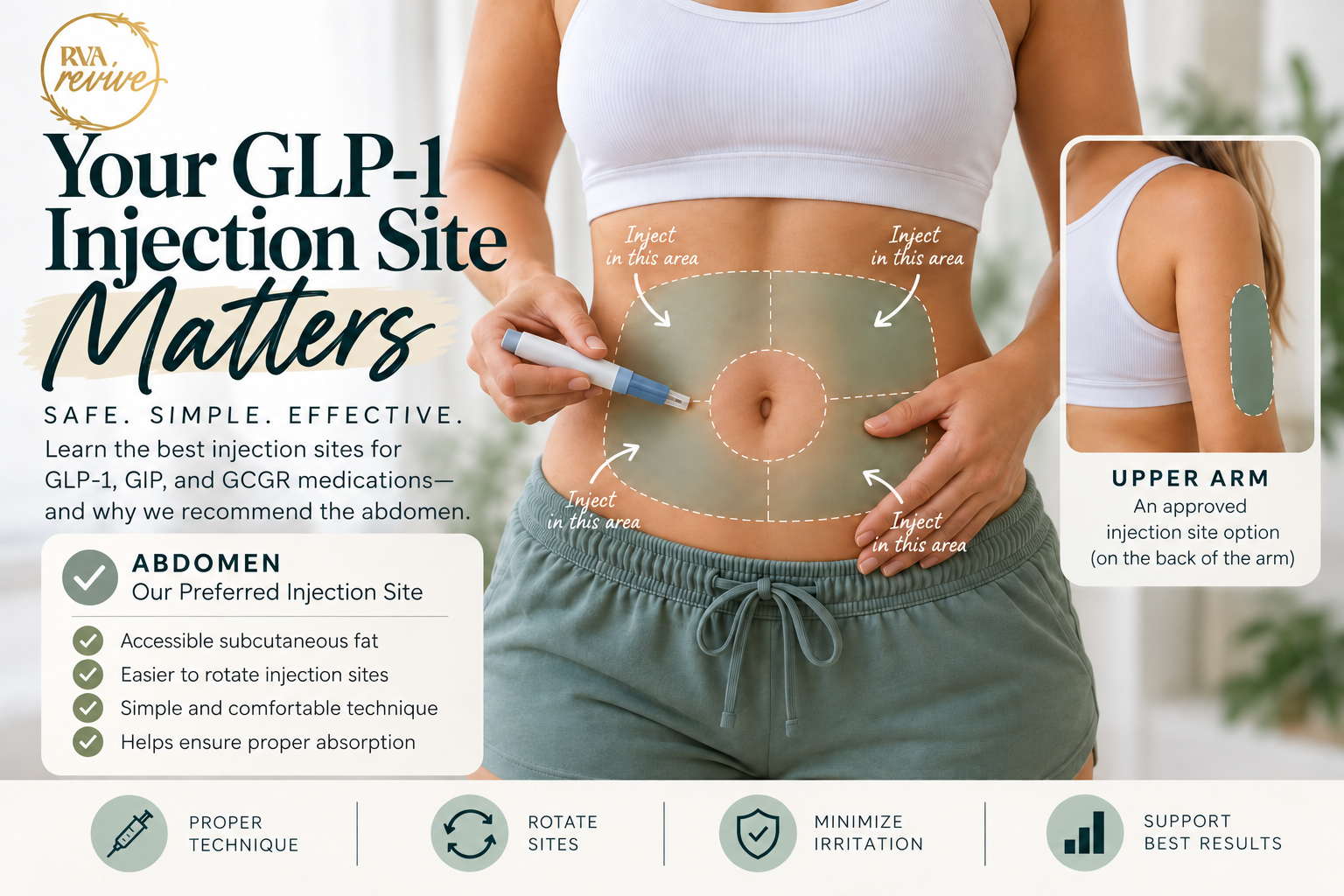
At RVA Revive, we generally recommend the abdomen as our preferred starting injection site when appropriate. While FDA-approved semaglutide and tirzepatide products can also be administered into the thigh or upper arm, we find that abdominal injections are often easier for patients to perform correctly and consistently.
1. Accessible Subcutaneous Fat
These medications are designed to enter the body through the fatty tissue beneath the skin. For many individuals, the abdomen provides an accessible layer of subcutaneous fat, making it easier to administer the medication at the intended depth. This is particularly helpful for patients who have less fatty tissue in their arms or thighs.
2. Easier Injection-Site Rotation
The abdomen offers plenty of room to rotate injection sites without repeatedly using the same small area. This matters because injecting into the exact same spot week after week can contribute to irritation, bruising, and changes in the tissue beneath the skin.
You don’t need to switch to a completely different body part each week. Simply choose a different location within the recommended abdominal area.
3. Comfortable and Consistent Technique
One of the biggest benefits of abdominal injections is accessibility. Most patients can easily see and reach their abdomen, allowing them to maintain better control over their injection technique. And when you’re administering medication at home, simplicity matters!
What About Injecting Into the Thigh?
The thigh is an FDA-approved injection site for semaglutide and tirzepatide, but it isn’t always our first recommendation.
Differences in subcutaneous tissue: Some individuals have relatively little fatty tissue in their thighs, especially those with a leaner or more muscular build. Depending on the needle and technique, this may make it more challenging to consistently administer an injection into the subcutaneous layer.
Comfort and accessibility: Some patients experience more discomfort with thigh injections or find the area less convenient to access.
Medication absorption: Blood flow, tissue characteristics, and injection technique can influence how quickly subcutaneous medications enter circulation. However, studies of approved semaglutide and tirzepatide formulations show comparable overall medication exposure across the abdomen, thigh, and upper arm.
This means there is currently no convincing evidence that injecting semaglutide or tirzepatide into the thigh produces less weight loss than injecting into the abdomen.
Our approach at RVA Revive: We often prefer the abdomen because it’s accessible, generally provides adequate subcutaneous tissue, and makes proper injection technique and site rotation easier.
How to Choose the Correct Abdominal Injection Site
If you’re using your abdomen, a few simple guidelines can help you choose a safe location.
- Stay at least two inches away from your belly button.
- Choose an area with healthy, intact skin and adequate subcutaneous tissue.
- Avoid areas with bruising, redness, tenderness, scars, or hardened tissue.
- Rotate your injection location each time rather than repeatedly injecting into the exact same spot.
- Follow the instructions for your particular medication and injection device.
You can alternate between different areas of your abdomen while maintaining a safe distance from your belly button.
Does Your Injection Site Affect Weight-Loss Results?
This is one of the most common questions we hear. While injection location can influence absorption characteristics for certain subcutaneous medications, approved semaglutide and tirzepatide products have demonstrated comparable overall exposure when administered into their recommended injection sites.
There is no established evidence that choosing the abdomen instead of the thigh will independently accelerate fat loss.
Your weight-loss results are influenced by several factors, including medication dose and consistency, individual metabolic response, nutrition and adequate protein intake, resistance training, physical activity, sleep, recovery, and underlying medical conditions.
The goal isn’t to find a magical injection spot that makes your medication work harder. It’s to administer your medication safely, correctly, and consistently.
Tips for More Comfortable Injections
A few simple habits can make your injection routine easier.
- Prepare your medication carefully. Always verify the medication name, concentration, prescribed dose, and expiration or beyond-use date before administering an injection.
- Wash your hands. Clean hands and proper injection supplies help reduce contamination risk.
- Clean the injection site. Use an alcohol swab and allow the skin to dry completely before injecting.
- Use a new needle every time. Never reuse needles or share injection equipment.
- Follow the correct technique. Injection angle, whether to pinch the skin, and other steps depend on the medication, needle length, and device being used.
- Avoid rubbing afterward. Gentle pressure may be applied if necessary, but avoid massaging the area.
- Rotate injection locations. Even if you always use your abdomen, move to a different spot with each injection.
A Special Note About Medication Concentrations and Syringe Units
This is especially important for patients using medications supplied in multidose vials.
Milligrams (mg), milliliters (mL), and syringe units are not interchangeable measurements.
Milligrams describe the amount of medication, milliliters describe liquid volume, and syringe units represent volume markings on an insulin syringe.
If your pharmacy changes the concentration of your medication, the number of syringe units required to deliver your prescribed milligram dose may change, even when your actual medication dose stays exactly the same.
Never assume that the same number of syringe units applies to every vial.
At RVA Revive, we encourage patients to contact our team whenever they receive a new vial and have questions about the concentration, labeling, or injection instructions. We would much rather answer a question before an injection than have a patient guess!
What If You Experience Redness or Irritation?
Mild tenderness, bruising, or temporary redness can sometimes occur after a subcutaneous injection. To help minimize irritation, avoid injecting into areas that are already tender, bruised, or inflamed.
If you develop persistent redness, increasing warmth, swelling, drainage, or significant discomfort, contact your healthcare provider. Severe allergic symptoms, including difficulty breathing or swelling of the face or throat, require immediate medical attention.
The Bottom Line: Proper Technique Matters
When it comes to injectable weight-loss medications, consistency and correct technique are key.
At RVA Revive, we generally favor abdominal injections because they are convenient, accessible, and often easier for patients to administer correctly. Other approved injection sites remain appropriate when used according to medication-specific instructions.
Remember, successful weight management isn’t about finding shortcuts. It’s about understanding your body, using your medication safely, and building sustainable habits that support your long-term health.
Have questions about your injection technique or medication concentration?
At RVA Revive, we’re here to help you feel confident every step of the way. Whether you’re just starting your weight-loss journey or have been using injectable medications for months, our team is happy to review your technique and answer your questions.
RVA Revive | Personalized Wellness, Medical Weight Management & Health Optimization
Medical disclaimer: This article is intended for educational purposes and does not replace individualized medical advice. Injection-site guidance is based primarily on FDA-approved injectable GLP-1 and GLP-1/GIP medications. GLP-1/GIP/GCGR medications remain investigational and do not have FDA-approved administration instructions. Always follow the directions provided by your prescribing clinician and the manufacturer of your specific medication.
Related Posts